13 August 2010

Magic.

Oz. Narnia. Wonderland. Never-Never Land. Consider our myths and fairytales, and you’ll see immediately that we humans crave magic. A deep, long-lost part of us must believe in it: decade after decade we teach these stories to our children. At a young age, we learn that if you shove aside the coats in your armoire, you will walk straight into a snowy kingdom where all your courage will be needed to fight the White Queen. Or that if a tornado strikes your house, you will land on a yellow brick road that takes you to the Wizard. Or that if you fall through a hole after being hurried there by a rabbit, you will find yourself in the midst of an epic battle between kindness and jealousy. Courage and magic intertwine at the core of our favorite childhood stories. My own favorite story, Charlotte’s Web, relies on the reader’s willing suspension of disbelief in farm animals’ ability to converse.

How does it happen that gradually such belief fades? Last month my three-year-old niece told me about a pink-and-blue tent she received for her birthday. When I asked her favorite thing about it, she replied, “Probably the lift-up door because I can lift it up and see what’s going on in there so I know if I want to play in it or go somewhere else with Mommy.” While I’m sure my niece knows that whatever might be “going on in there” is strictly her imagination, I’m betting she’d be an easy sell on all things magical. After all, to the young brain, both Santa Claus and rainbows are magical. How did exactly the toys you wanted appear under the tree sometime during the night on Christmas Eve? Somehow Santa must’ve done it. How does light shooting through suspended water droplets cause a bursting forth of colors in the same order every single time? Somehow God must’ve done it.


When it comes to faith, instead of harboring a childlike willingness to believe in magic, we enter into these ridiculous adult arguments about old earth versus new earth, or literal versus figurative. Those conversations might be enjoyable or even faith-building to some, but when they split friendships and churches—as they often do—something is wrong. Consider the words of Jesus in the Book of Mark: Let the children come to me. Don’t stop them! For the Kingdom of God belongs to those who are like these children. I tell you the truth, anyone who doesn’t receive the Kingdom of God like a child will never enter it (Mark 10:14b-15, NLT). Can you imagine children arguing whether Jesus turned water into wine or grape juice? Whether the Flood actually killed everything except that which was literally on the ark? Kids eat up Bible stories: they’re pure magic. You hear a lot more cries of “Cool!” than snorts of “This is obviously not meant to be taken literally” when you teach children’s Sunday school. And clearly, this is what Jesus is after—unbridled enthusiasm and belief in all things magically God. Luckily for most of us, Jesus doesn’t say, “Anyone who doesn’t receive the Kingdom of God like a theologian will never enter it.”

Am I taking issue with the discipline of theology? Certainly not. Am I suggesting that all sophisticated and/or inquiry-driven considerations of God should be quashed? Not at all. But I do wonder why we can’t go back to our child selves and be willing to accept a little more magic at face value. A fourteen-year-old Middle Eastern girl who’d never had sex in gave birth to God’s child? Let’s just go with it. As we’ve learned from the oft-quoted passage, Faith is the confidence that what we hope for will actually happen; it gives us assurance about things we cannot see (Hebrews 11:1, NLT). What is that if not a definition of believing in magic? So what if we can’t see God? Let’s just believe he’s there. We’ve never seen the wind or Neptune either, and we believe they’re out there. Maybe it’s time to peek back in that armoire with the children and see what they teach us about God.

12 August 2010

Rainbows.


So when…I'm all by myself / And I can't hear You answer my cries for help / I'll remember the suffering Your love put You through / And I will go through the valley if You want me to.
— “If You Want Me To” by Ginny Owens

I didn’t grow up in a Christian denomination that spoke much about grace. Instead, sermons of sin, God’s displeasure, and the weakness of humans abounded. Once, a pastor informed my youth group that there was a specific formula one must follow when praying: God wouldn't listen otherwise. An evangelist who came to my church when I was barely a teenager suggested that those who weren’t filled with the Spirit might not be saved, and the only way to be sure you’d been filled with the Spirit was whether you’d spoken in tongues. For this reason and others, I grew up doubting the grace of God as frequently as I went to bed at night—and if I were being honest with myself, I’d have to say that I still sometimes have relapses. Every night for years and years, I prayed the sinner’s prayer just in case Jesus came back in the night. I wanted to cover my bases in case the last 24,591 sinner’s prayers didn’t take.

It’s no great surprise, then, that when I was eighteen years old, I was sure that God had revoked my salvation privileges forever. Looking back over my life, there were lots of things I regretted thinking or doing—from saying disrespectful things to my parents to making fun of people at school. Drugs, alcohol, and sex—the trinity of Big Sins—might never have tempted me, but there was still an undeniable sinfulness at my core. I kept praying words like, “I know You’re probably not listening anymore, but even if I can’t be saved, I’ll still try to live like I am. I still believe in You, and I’ll try to send others Your way. I’m just sorry I’ve screwed up so often, and this relationship didn’t work out any better.”

I remember praying exactly that way as my family drove to my aunt’s house one Friday afternoon. I was feeling especially bold that day, and asked God if he wouldn’t mind sending me a sign if in fact I hadn’t quite used up my grace allotment yet. “I know I’m probably overstepping the bounds here a little,” I whispered tentatively, “but if there’s still a little grace with my name on it, would you let me know?” I fell asleep, praying that prayer over and over. When I woke up from my nap, I swear the first thing I saw was a rainbow. Now, a rainbow might not mean much to you, but here’s what it says about them in Genesis: Then God said, “I am giving you a sign of my covenant with you and with all living creatures, for all generations to come. I have placed my rainbow in the clouds…When I send clouds over the earth, the rainbow will appear in the clouds, and…when I see [it], I will remember the eternal covenant between God and every living creature on earth” (Genesis 9:12-14, 16, NLT). So every time God sees a rainbow, he remembers his covenant with us: he has guaranteed us love, grace, and protection from the perils of life on earth. It only seems fitting that if that’s what’s on God’s mind when he sees a rainbow, the same can be true of me. I spent the next several moments in the car contemplating the mercy of God…until I began talking myself out of the message. “Mercy for others, but no longer for me,” I reminded myself, frustrated that I’d been swept away by the magic of nature. “God is merciful to those who have more self-control than I have and can keep themselves from sinning.”

A few months later, it was January of 2003, and I was in a church service with my then-boyfriend. I don’t remember what the minister preached about that morning, but I do remember the overpowering urge to ask for prayer. I was still struggling (privately) with the feeling of being outside the bounds of salvation, but that rainbow had sent a tiny ray of light into my being, causing me to question if all really was lost. Almost immediately after I walked up to the altar, a woman joined me and began praying for me, praying all the things I wanted to say but didn’t feel that I could. Without ever asking why I was at the altar, she told me that God found me beautiful, treasured, and even holy. She told me that God did not take kindly to his children being terrorized by Satan’s lies. She told me that God roars like a lion against anyone who bullies, mistreats, or harms one of his own. She told me that I was precious and forgiven…and I believed her. I finally believed that I was still accepted and that God was welcoming me to his side. My body crumbled to the floor, and for a long time I sat in the presence of the Lord, letting grace and peace flood me. I belong to Jesus, I belong to Jesus, I belong to Jesus…

That night I ate dinner at my boyfriend’s house, and then we all took our regular spots in the sunroom. His mom sat on a wicker chair in the corner, and he and I settled onto a glider. In moments, the sun was setting in the most unbelievable way: the sunset was quite literally a gigantic rainbow that spanned the entire sky. Red, orange, yellow, green, blue, indigo, violet…they were all there in order as the sun slipped below the horizon. We marveled; none of us had seen a sunset like that ever before. (And while I can’t speak for them, I can say that I haven’t seen anything remotely like it since.) Remember? I heard the word echoing somewhere within me. Remember? God reminded me that we had a covenant, he and I. He’d painted both rainbows—skywriting, really—to remind me of the immense love he harbors for me. If I hadn’t already believed that God had power even over the colors of the sunset, I certainly did then.

Ever since, I have sought rainbows. Although, I usually don’t even have to: if I am going through a trying time, if something is weighing heavily on my mind, a rainbow will inevitably appear. God always reminds me of his ultimate control over the situation and of my privileged place in his family. Just yesterday I tearfully returned to my apartment in Virginia after spending a fabulous week of respite at home. I begged the Lord to tell me why I’m having to go through this—being away from home, family, and friends—in order to get a degree I’ve fallen out of love with. He didn’t answer, but did send a rainbow to meet me along the interstate. I love you more than words can express, remember?

22 July 2010

Patriotism.


The night before we left, everyone got together for a final group dinner. Before long, as always happens at such functions, conversation wound around to our thoughts about leaving France. Some of us avions hâte (“had haste”) to return to the States; others were more saddened that it had come to an end. At one point, someone asked, “What will you miss most about France?” Although I said nothing at the time, my answer was definitely “the people”. As I have said before, I believe that learning a foreign language is all about learning to listen—decoding others’ ways of speaking, if you will. This trip only confirmed my beliefs, as I listened to some incredibly interesting people during my time in the country. Their stories amaze me and made me grateful for the professors over the years that have taught me how to listen to French.
One such story came from Madame D, whom we met at the Museum of Resistance and Deportation. Mme D was not even a teenager when World War II broke out, but she became a Resistance fighter in Lyon. She was raised speaking both French and German because her father believed that World War I wasn’t over, and if the Germans came back, he wanted his family to be prepared. Whenever they complained that other families didn’t have to learn other languages, he replied, “Il faut parler la langue de l’ennemi” (“It’s imperative to speak the language of the enemy”). But it wasn’t just at home that she learned how to fight the Germans: at school she was taught that France was the most beautiful, most intelligent, most strategic country on the planet. If she and her classmates stayed in school and then used their knowledge as employees of the State, they would make France a formidable opponent for Germany.
With such patriotic and idealistic talk swirling constantly around her head, it’s no surprise that Mme D began believing it. When Hitler and Pétain signed the armistice on 22 June 1940, 12-year-old Mme D (at that time, Mademoiselle D) was already looking for a way to fight the Germans. She didn’t have to look long before she was given a task: Libération-Sud, a Resistance group in Lyon, gave her clandestine newspapers to distribute every evening. Each morning, Mlle D went to school like every other 12-year-old girl in her country, innocent as a butterfly. When school let out, she rode her bike to the secret headquarters of Libération-Sud to collect an armfulof newspapers, which she distributed swiftly to other members of the Resistance group, a vital cog in the greater communication machine. This 12-year-old girl was willing to put herself in risk of death every afternoon because she loved her country and believed in its potential for victory.
We U.Va. students were floored as we listened to Mme D’s tales of bravery. She didn’t tell them in a proud way; she didn’t even seem emotionally affected by the words coming out of her mouth. I found myself wondering, Would I have been willing to do what she did? Would my students be willing to go to such great lengths for freedom and country? Is this woman extraordinary for answering the call of duty, or would most of us do the same in her shoes? I have to admit, I don’t really know the answers to any of those questions. But I do know that people her age often have much more patriotism, regardless their native land, than those my age and younger. Why is that? Have we become spoiled in our less war-torn era? Are we only willing to do that which increases our own social or economic statuses? Have we simply become too angry about the decline of the global economy? Is the crevasse between the political parties eroding our love of country? Why don’t we put our hands over our hearts when we hear the anthem? Why do we only think about our country during national elections, heated political discussions, or while watching Harrison Ford action thrillers?
Not that the situation in France is any better. On Bastille Day, as I was enjoying a fireworks show at one of the grad students’ apartments, someone asked my theatre professor whether she was feeling especially patriotic. She said, “Absolutely not. Today everyone gets drunk, lights fireworks, and sings ‘La Marseillaise’ [the French national anthem]. That’s all. And that’s such a violent, xenophobic song. None of these things inspire patriotism in me. Besides, the fireworks aren’t even good tonight.” N, one of the grad students, said that he had heard several other French people answer his question similarly. Somewhere between the Mme D generation and the Professor B generation (the two women are about 40 years different in age), the patriotism evaporated.


Of course, the fierce nationalism that brought on World War II is to be avoided at all costs. No country is inherently better or more valuable than another, and that’s important to remember lest we start feeling too sure of ourselves. And a more peaceful world is certainly a goal worth working toward. However, what country can withstand national trials and hardships without a basic love of homeland? Can we survive without patriotism?

11 July 2010

Adieu.

French, like English, offers its speakers a number of ways to say goodbye, most of them dependent on when you expect to see each other again. A tout à l’heure has one of the smallest lapses of time between departure and reunion: it translates loosely to “within the hour,” although in conversational French it’s just used for “see you very soon.” There is the weekday staple a demain!, which means “until tomorrow.” From there, you have your generic goodbyes of indeterminate length but with certain reunions, expressions like salut for your friends and au revoir for your superiors. Then, there’s the scary one. It connotes a forever goodbye, quite literally translating “to God,” as in “I commit you to God.” This is a very certain goodbye, not one that had ever been said to me, not even mistakenly from a student, until today.
E and I were at the market for the last time this morning, picking up our final selections of bread, cheese, fruits, and vegetables. On our way out, I stopped at the Bread Man’s stand because I just couldn’t pass up being his customer one last time. Besides, he had my favorite bread, pépites au chocolat, which he hasn’t had since that first week. It was a sign.
When we approached his display, he said, “Ah! You were in Avignon, no?” Surprised at his remarkable memory—he must see a few hundred people pass by every Sunday—we replied that indeed we were. “You went to see the plays of the festival. I remember. I went there myself once, spent an enjoyable weekend there. This is a good tradition of France.” We agreed that we too had had a great time in southern France but that we were glad to be back in Lyon. I ordered my pépites au chocolat loaf and then informed him that it was our last market visit before returning to the States. “I had to come back once more for your bread!” I said with a smile.
He raised his eyebrows. “Your last market?” He shook his head. “When do you return? You are American, no? Going back to America?” We told him he was right and that our planes for America would leave on Saturday. “What city will you go back to?” For simplicity’s sake, E and I just gave him our home states. “Well, I must take my breads to America then! You have nothing like this in America. All factory breads!” We all chuckled as he handed me my box. “Well, I guess this is adieu then,” he said with a regretful expression. “Yes, adieu.” I nodded, almost tearing up, and echoed his goodbye.
It’s amazing that someone I spoke to for only a few minutes each week could cause such emotion in me. But this, this is why I chose language for my career. You learn a language so that you can hear other people speak: their stories, their joy, their pain, their fragility. You learn a language so that you can appreciate the Godlikeness of other people. You learn a language so that you can laugh with them, understand them, be welcomed by them and welcome them in return. That’s why it’s so close to God’s heart. He said at the dawn of mankind that it’s not good for us to be alone.
The Bread Man and I never spoke more than ten minutes at the time. We don’t even know each other’s names. But for four weekends, we looked forward to seeing each other and exchanging a few words of conversation in his native language. He clearly enjoyed regaling E and I with brief stories of traveling to Avignon and America and with proud claims of the superiority of his bread to anything else at the market or across the ocean. I enjoyed hearing it. That, if you ask me, is a little bit of God showing up in everyday life.

07 July 2010

French Food.

There’s no doubt about it: France lusts over food. From the hours spent preparing it to the hours spent consuming it, food crosses the French mind every day à plusieurs reprises (“at many repeats”). On any block in France, you will find store after store devoted to alimentation—bakeries, butchers, dairy shops, confectioners, produce markets, and so on. Cafés never lack patrons, even in the middle of the day. French air is overflowing with the aromatic mélange of roasted chicken, garlic, bread, sautéed onions, cheese, coffee, chocolate…Can you smell it yet? It only fits, then, that many of our activités culturelles obligatoires (“required cultural activities”) have centered on consumption and “palate education.”

Sunday, 20 June: Huge group dinner at the Le Nord Brasserie Bocuse, a four-star restaurant in Lyon. Our reservations were at 7:00 p.m., but we didn’t leave until after 10:30—which is actually common in France. If you want to have dinner at a restaurant, not just a café, you’re expected to make reservations. The restaurant, however, only accepts as many reservations as there are tables. After it fills up, the doors are closed and customers can stay until all hours. And it’s a good thing: the food at Le Nord was absolutely delicious. It took all three and a half hours to eat it slowly enough to savor every bite and enjoy the company, too.

Thursday, 24 June: Small group dinners. Our group opted for traditional Lyonnais cuisine, so our professor made reservations at a bouchon, an establishment that serves exclusively Lyonnais food. There again, the meal was incredible. I had French onion soup, quenelle (a soufflé made of cheese, a rich white fish, and spiced cream), and profiteroles au chocolat, the largest chocolate dessert I have ever seen. (I wasn’t sure exactly how to translate profiterole, so I looked in the New American Oxford Dictionary: “a small hollow pastry typically filled with cream and covered with chocolate sauce”. Ohhh, yeah.) Much of Lyonnais cuisine is that which I imagine is served at the gates of hell: tripe sausage, tongue, fish heads, cow brains, and so on. Nonetheless, it’s possible to find more edible dishes, which was the case at our bouchon. I will post pictures when I get back home.

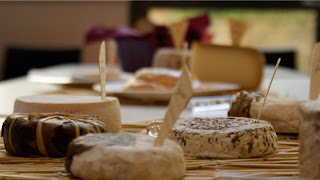
Sunday 27 June: Cheese tasting. You’ve probably heard rumors that French cheese is some of the weirdest and stinkiest on the planet. I concur. But much of it is delicious, despite the olfactory displeasure. Our job on this particular evening was to amble around the room, trying different cheeses, and describing each with words other than “strong” or “stinky.” That left us hard pressed for appropriate adjectives. However, I found a fantastic cheese made of sheep’s milk that had a nutty, buttery taste. That stuff was incredible with some water crackersand a sip of white wine. Three or four of the cows’ milk cheeses were also fantastic: smooth, creamy, and slightly salted. All of those were the perfect compliment to a baguette. Of course, there were others that tasted like feet, acid, and/or poisonous mushroom, so I stuck mostly to my favorites.

Monday, 28 June: Cooking workshop and winetasting. That’s right: I attended a cooking workshop with a professional French chef. We prepared a chicken-and-pesto main dish with sides of tomates Provençal (“Provence tomatoes,” which are roasted in olive oil, garlic, and basil) and sautéed zucchini. The other half of our group made a sushi appetizer and a raspberry cake with warm compote of tomatoes (yes, tomatoes) and strawberries for dessert. It was terrifying to be in the kitchen of a French restaurant with a guy who does it for a living, let me tell you. It’s amazing how much school they have to go through to be hire-able in the restaurant industry in France. Very intimidating for those of us who struggle with our microwave oatmeal. Anyway, while one group was cooking, the other was in a wine tasting. We did essentially the same thing with the wine that we did the night before with the cheese: describe what we smelled and tasted. Naturally, I liked the white wine best—it was fruity, floral-y, and crispy. We also tried a rosé and a red; the red was surprisingly good. It’s weird to describe a drink as peppery and smooth, but that’s exactly what the red wine tasted like. Too hardcore for me, but I could tell it was of exquisite quality.

Thursday, 1 July: Couscous dinner. Couscous? Is that really a meal, you might ask. Well, no, not usually. Usually it’s a side dish, similar in style (but not in taste or consistency) to rice or other grains. However, at L’Étoile de l’Orient, it is the main attraction. The servers first brought us green aperitifs with a minty-lime taste. Although small, they were refreshing since we were positively baking on the top floor of the restaurant. The meal was served family-style: a dish of plain couscous occupied the center of the table, flanked by a giant bowl of vegetable stew and a gargantuan platter of baked meat. Everyone dug in heartily and delighted in the spicy Moroccan specialty. The portions were so much more than I could ever eat, but I ate until I could hardly wiggle. Before the night was over, one among us who is Canadian sang “O, Canada!” (his version deserves an exclamation point) in both French and English to celebrate Canada Day. To quote Jen from CakeWrecks: “I didn't even realize that the US celebrated Canada with its own day.”

Sunday, 4 July: French-style Independence Day feast. This was just an E and I thing, not the whole group. We wanted somehow to celebrate our patriotism, but the hot dogs here just wouldn’t cut it. They’re served on baguettes. That’s right, baguettes with wieners inside. So, E found a café whose plat du jour was moules-frites (“mussels and fries”). We figured that was as close as we were going to get. I mean, hey, it had fries with it. (Yes, I understand the irony of being in France, trying to find American food, and ordering “French” fries. [Which are not French, by the way. Just wanted to clear that up.]) It was a lovely evening, sitting there in front of the Saône River, chowing down on mussels and fries. But I don’t think I’ll ever order mussels in America: they looked too much like insects with soft flesh.

Tuesday, 6 July: Ice cream. There is an ice cream shop here in Lyon with over sixty flavors. Put that in your pipe and smoke it, Baskin-Robbins. Granted, some of their flavors would never make it in the U.S. because they are, in a word, weird. Exhibit A: flower flavors. At the Nardonne ice cream shop, you can order rose, violet, or orange blossom ice cream. Another graduate student, braver than I, ordered violet. She let me try it, and all I can say is that it tasted like smelling purple. I ordered mint, hazelnut, and Nutella, which formed a winning combination. Assuming E and I go back on our own—the chances are pretty high—I think I’ll try dark chocolate, salted caramel, and cinnamon. So many flavors, so little calorie allowance.

Reading back over this, I have three thoughts: 1) How in the world have I lost eleven pounds since being here? 2) The next few days we’ll be in Avignon at the theatre festival and eating most of our meals at the YMCA. Good thing we’ve been stocking up on delicious food up until now. 3) I’m seriously hungry. Time for dinner.